
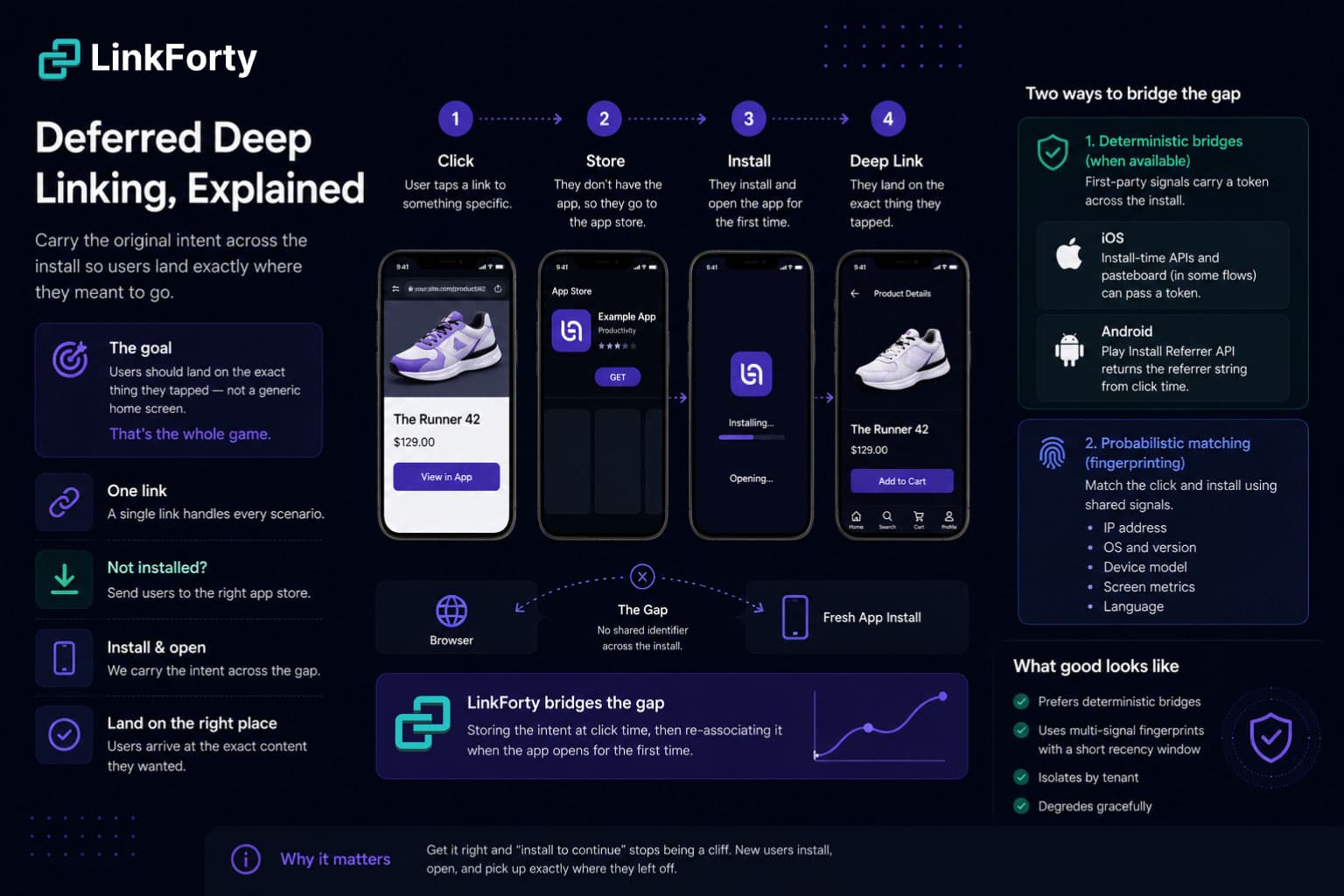
The gap between a click and an install
Ordinary deep links assume the app is already there. Deferred deep linking is for the moment it isn't:
- Someone taps a link to a specific thing — a product, a shared document, an invite.
- They don't have the app, so they land in the App Store or Play Store.
- They install and open the app for the first time.
- They should land on the exact thing they tapped — not a generic home screen.
Step 4 is the whole game. Without it, every "install to see this" flow loses people at precisely the moment they were most interested. Deferred deep linking carries the original intent across the install so the app can finish the job.
Why it's hard: the app stores are a wall
The problem is that the click (in a browser) and the first app open (a brand-new install) happen in two different worlds with no shared identifier between them. The App Store deliberately doesn't pass any context to a freshly installed app. So the destination that was known at click time has to be re-associated with the install after the fact.
There are two broad ways to bridge that gap.
1. Deterministic bridges (when available)
Some platforms offer a first-party channel that carries a token across the install:
- iOS: install-time APIs and, in some flows, the pasteboard can hand a token to the fresh app.
- Android: the Play Install Referrer API reliably returns a referrer string that was attached at click time.
When these are available they're exact — a token in, the same token out. Deferred deep linking should always prefer them.
2. Probabilistic matching (fingerprinting)
When no deterministic bridge exists, you fall back to matching. At click time you record a lightweight device fingerprint — IP address, OS and version, device model, screen metrics, language. On first app open you compute the same signals and look for a recent click that matches.
This is probabilistic, so it lives and dies on the matching rules:
- Recency window. Match only against clicks in the last few hours; the longer the window, the more collisions.
- Signal strength. IP address plus a couple of stable device attributes is far stronger than IP alone — especially behind shared NATs and carrier-grade proxies, where thousands of devices share an address.
- Scope. Never match a click from one app or workspace to an install of another. Cross-tenant leakage produces phantom attributions that quietly corrupt analytics.
The failure mode nobody talks about: over-matching
Under-matching (missing a real install) is obvious — the user lands on a blank home screen. Over-matching is the silent one: two different people behind the same corporate IP, a coarse fingerprint, and a wide time window, and the app confidently routes person B to person A's content. It looks like it's working. It's inventing attributions.
The fix is discipline, not cleverness: tight recency windows, multi-signal fingerprints, and hard tenant isolation. When a match isn't confident enough, it's better to route to a clean default than to guess wrong.
What good looks like
A solid deferred deep linking implementation:
- Prefers deterministic bridges (Install Referrer, install-time tokens) and only falls back to fingerprint matching.
- Uses multi-signal fingerprints with a short recency window.
- Isolates by tenant so one app's clicks can never attribute to another's installs.
- Degrades gracefully — an unmatched install still gets a coherent first-run experience, never a broken one.
Get it right and "install to continue" stops being a cliff. The new user installs, opens, and picks up exactly where they left off — which is the entire promise of a deep link, extended across the one boundary that used to break it.